The Liturgical Institute
The Liturgical Institute | News
-
Liturgical Institute Graduates Largest Class Yet As Cardinal George Confers Degrees at University Commencement
At its May 5, 2012 commencement exercises, the ecclesiastical and academic faculties of the University of St. Mary of the Lake conferred diplomas on eleven Liturgical Institute graduates. Cardinal Francis George, OMI, Chancellor of the University and founder of the Liturgical Institute, personally presented diplomas to each graduate. Held in the Cardinal Mundelein Auditorium, the ceremony included an address by former Mundelein Seminary faculty member, Sr. Kathleen Mulchay.With eleven graduates comprised of six Master’s degrees, four Licentiates and one Doctorate, the 2012 class represents the Institute’s largest graduation class to date.
Newly-minted doctor Fr. Joseph Lionel earned his degree by defending his dissertation entitled Continuity in Liturgical Renewal: A Critical Analysis of the Prefaces for the Five Sundays of Lent in the Missale Romanum 1570 and 2002 and the Foundations in Scripture. He is now a faculty member of St. Peter’s Pontifical Seminary in Bangalore, India.
Among the graduates earning the degree of Licentiate in Sacred Theology, Fr. Geoffrey Kerslake, Episcopal Vicar of the Archdiocese of Ottawa, Canada, brought together theology and architecture in a thesis entitled The Influence of Dionysius the Areopagite on Abbot Suger: Are Dionysian Themes Reflected by Design or By Accident in the Abbey Church of St.-Denis? Fr. John-Mark Missio, now a seminary professor in the Archdiocese of Toronto, Canada, investigated the requests of Pope Pius X to define sacred music as holy, excellent in form and universal. Entitled Pope Pius X and the Attempt to Define Sacred Music, his thesis made recommendations for the current day by studying the “inner nature” of music as a means for determining its proper form.
A priest of the Archdiocese of Chicago, Fr. Manuel Razo made a study of the origins of the Eucharist in a thesis entitled The Jewish Background of the Eucharist, comparing the writings of Odo Casel, Anton Baumstark and Louis Bouyer. Lastly, Mr. Owen Vyner, presented a thesis entitled The Contribution of the Sacrament of Penance to a Conjugal Spirituality: The Signification of Marriage and the Body in the Thought of Dietrich von Hildebrand and John Paul II. Vyner’s work was considered so excellent as to be presented in the Institute’s Hillenbrand Lecture Series.
Mr. Joseph Wagner earned his Master of Arts (Liturgical Studies) degree with a thesis centered on the relationship of individual transformation within the worship of the Mystical Body by studying the modern Liturgical Movement and the theology of Joseph Ratzinger and Alexander Schmemann. Joe has since begun studying for the priesthood at Mundelein Seminary. His classmate, Fr. Romanus Nwaru, entitled his thesis Lex Orandi, Lex Credendi: Exploring an Ancient Maxim, taking a fresh look at this well-known phrase.
The Cardinal also awarded four Master of Arts in Liturgy degrees, first to Dr. Claudia Dado, whose project, The Liturgy of the Hours: A Model to Implement the Prayer of the Church in the Parish, resulted in the regular prayer of the Divine Office in her local parish. Fr. John Baptist Nguyen, op, a Dominican priest from Calgary, Canada, was asked by his local ordinary to address the alarming statistics that over 60% of the high school students in his local Catholic high school were not confirmed. His master’s project, entitled Journey of Faith to Encounter Christ in the Sacraments of Initiation: A New Implementation for High School Students, was developed to address this pastoral need.
Father Don Bosco Selvaraj, a priest from India, chose to approach the question of the Sacrament of Reconciliation within the context of the several major religions operating in his diocese. Calling his project Preparation for the Sacrament of Reconciliation Today in the Context of the Diocese of Kumbakonam, India, this multicultural approach addressed notions of sin and forgiveness in Buddhism, Islam and Christianity. Lastly, Mr. Evan Stricklin, who works at a Catholic parish in New Jersey, developed an educational program for the implementation of the third edition of the Roman Missal, calling his project Glorify the Lord by Your Life: Discovering Active Participation in the Mass by Way of the New Roman Missal.
Our liturgical Institute graduates are now serving the Church around the nation and the world, bringing the Institute’s unique blend of fidelity, joy and prayerful preparation to the people of God. Congratulations to our 2012 graduates!
-
Fr. Robert Barron Offers Thoughts on 2 Samuel and Sacrifice in the Hillenbrand Distinguished Lecture Series
During its summer 2012 session, The Liturgical Institute welcomed The Very Reverend Robert E. Barron to offer a talk in the Institute’s Hillenbrand Distinguished Lecture series. Giving his first public address after being named President/Rector of the University of Saint Mary of the Lake/Mundelein Seminary, the noted proponent of the new evangelization provided insights from his research for an upcoming book on the Second Book of Samuel.Entitled “David Dancing Before the Ark: The Liturgical Theology Implicit in 2 Samuel 6,” Fr. Barron’s lecture addressed the role of King David as a new Adam, “leader of a properly defended Eden.” More than a king, Barron argued, Adam had also been a priest who, walking in easy fellowship with God, was naturally in the stance of adoration. Yet after the Fall, the world suffered a “suspension of right praise as a consequence of a failure in priesthood.”
In second Samuel, Barron argued that David becomes a priest because he presides over a “liturgical kingdom,” and so Samuel chose 30,000 men to recover the Ark of the Covenant and return it to Jerusalem that he might center his liturgical empire around right praise. Barron then turned his attention to the “sacrificial history and attitude of Israel presided over by the one who is not only King but priest as well.” Only in relationship to Adam can David’s dancing before the Ark be properly understood, Barron claimed, since Adam “danced in unison with the Lord,” while a sinful people felt “out of step with God.”
David therefore danced before the Ark as an image of “humanity dancing with the Lord, recovering the effortless harmony of Eden.” Fr. Barron then noted that the “gestures and movements of the priests in the Jerusalem Temple were intended to mimic, in a stylized way, the exuberant dance of King David. And since the ritual moves of the Byzantine and Catholic Mass trace their origins to the Temple,” one could conclude that the “processions, gestures, and bows of Christian priests today participate in the priesthood of the king who wore the ephod as he danced before the Ark.”
Before the talk, Liturgical Institute director Fr. Douglas Martis gave Fr. Barron a historic photo of Msgr. Reynold Hillenbrand, for whom the lecture series is named, and to whom Barron looks as a role model for his own time as Rector. Many thanks to Fr. Barron for sharing the fruits of his labors with us.
-
Courses and Faculty Announced for 2013 Summer Session
Join the Liturgical Institute for its 2013 Summer Session!
Session I, June 10 to June 28
Session II, July 1 to July 19
At The Liturgical Institute, you’ll find a positive, joyful and faithful approach to praying and studying the Church’s liturgy. Maybe it’s the friendly nature of our students, faculty, and staff, the pastoral setting of the campus and its beautiful architecture, or the ease with which the Tradition and magisterial teaching of the Church are integrated into a curriculum firmly rooted in the ideals of the Second Vatican Council. Perhaps it’s the sung Mass and Liturgy of the Hours, the field trips, the meals and impromptu discussions, and high quality of instructors and visiting speakers. There’s a remarkable experience to be found at The Liturgical Institute, one which will help refresh your soul and renew the Church. Summer 2013 courses and faculty include:
Liturgical Traditions East and West, Fr. Thomas Baima, The Liturgical Institute
Ritual, Symbol and Worship, Mr. Christopher Carstens, The Liturgical InstituteReconciliation, Anointing and Death, Fr. Dennis Gill, Archdiocese of Philadelphia
Music and Worship, Fr. John-Mark Missio, St. Augustine's Seminary, Ontario, Canada
For more information, visit the Summer Session page by clicking here. -
Love Connection at the Liturgical Institute
They knew they were coming to the Liturgical Institute's 2011 and 2012 summer sessions to learn about the Sacred Liturgy. Little did they know they would wind up engaged to be married. Evan Stricklin, a pastoral associate from New Jersey, came at the request of his pastor to further his liturgical education. Ruth Ristow, an artist working at Xavier College Prep in Phoenix, came to learn about sacramental aesthetics and liturgical art and architecture.Then Cupid hit.
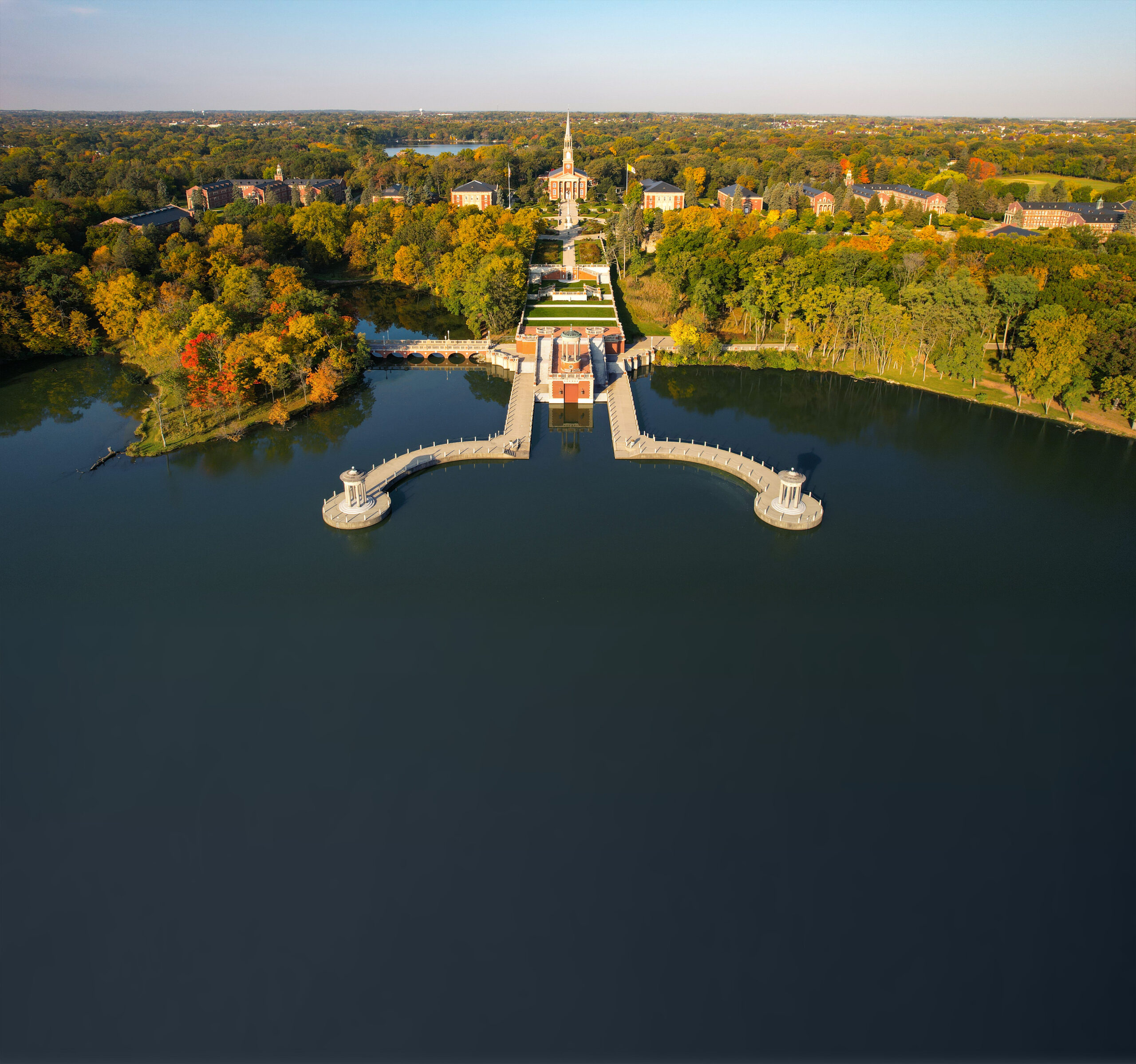
Two years later, Stricklin and Ristow returned to the campus on Valentine's Day, 2013, where Evan popped the question on the University's beautiful lakeside pier. No wedding date set yet, but the Institute offers its heartiest congratulations and promise of prayers for a blessed and happy marriage.
-
Online Audio Files for the Sacred Triduum
Pray along with the Liturgical Institute from the Mundelein Psalter!
Want to celebrate Morning and Evening Prayer from the Mundelein Psalter, but need help with the tones and hymns?
Click here to hear the Mundelein Psalter Triduum online audio files.