Sacred
Heart Parish Pastor“The Mass is not so much our worshipping, as Christ worshipping through us, the articulated Praise in the Trinity, the Word made flesh. We must not be silent lest the Word be hushed in us. It is time to get on with the task.” – Reynold Hillenbrand, 1956 |
|
Coming to Sacred Heart Parish, Hubbard's Woods, Illinois appointed July 15, 1944
|
|
Hillenbrand
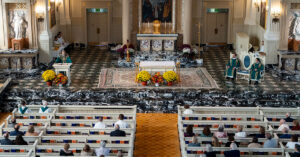
is shown at left in Sacred Heart Church after the 1957 parish renovation.
As a pioneer of liturgical reform, Hillenbrand sought permission to say
Mass “facing the people” in the late 1950s, shown here in the short
interim period when tabernacles were still placed on altars. |
|
Hillenbrand's Renovation of Sacred Heart Church ![]() ![]() |
The 1957 renovation of Sacred Heart Church was Hillenbrand’s most significant intervention in the parish’s physical plant. Hillenbrand knew well the artistic leaders of the Liturgical Movement, and was himself a member of the Board of Directors of Liturgical Arts magazine. Hillenbrand was greatly influenced by the architectural standards of the day, which saw the altar, freestanding tabernacle, crucifix and rear wall hanging to constitute the “liturgical altar.” His renovation, which did not occur without significant resistance on the part of some parishioners, reveals the somewhat radical influence of the dominant architectural establishment, which considered historical styles “fakery” and preferred singularity of image to multiplicity. The Gothic high altar was given to St. Mary’s Church in Fremont Center, Illinois (where it remains today) and side altars were removed so as to have only one altar in the church. The crucifix and sculptures of the Blessed Virgin and Saint Joseph were completed by Ivan Mestrovic. Hillenbrand’s signature intervention was the “Vine and Branches” sculpture by Joseph O’Connell on the rear wall of the sanctuary, a reminder to the people of their status as Mystical Body of Christ. The baptistery was moved to the front of the church to reinforce the connection between baptism and Eucharist. While Hillenbrand’s renovation was certainly foreign to the architectural lines of the existing church, it nonetheless preserved the use of high quality marble for the altar and sanctuary and the highest level of craft, reiterating the importance of the sacred building and sacral action. |

Sacred
Heart Parish Pastor
Though
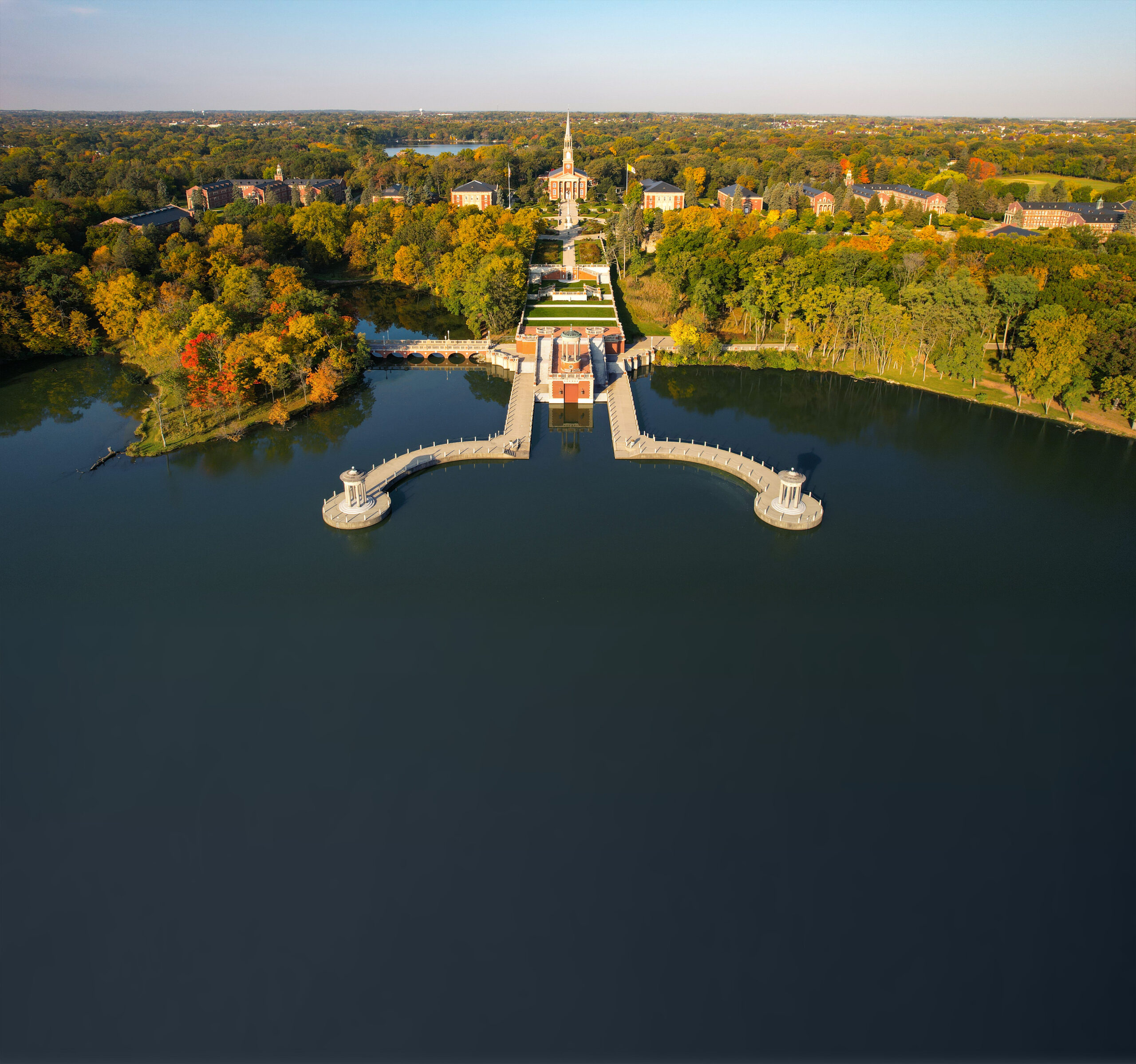
Hillenbrand's tenure at Saint Mary of the Lake Seminary was notable
for its liturgical and theological innovation, several forces converged so
that he would be “promoted” to the pastorate at Sacred Heart parish in
Winnetka, Illinois. Though Hillenbrand’s fame grew on the local and
national levels, mixed responses came to his policies and products, as
pastors, faculty and business leaders protested his ideas. The newly
ordained men coming from the seminary were appearing in parishes full of
new ideas on liturgy and social justice not always appreciated by their
pastors. Hillenbrand worked systematically to replace the
Mundelein-appointed Jesuit faculty with hand-picked diocesan priests
sympathetic to his own ideals, and business owners saw him as unswervingly
biased in favor of labor. Moreover, Hillenbrand’s many commitments
required frequent travel and took him away from the seminary.
Hillenbrand’s famously aloof personality did not help his cause.
As
the years progressed, Hillenbrand expanded his program to help
parishioners understand and participate fully in the Mass. He began a
boys’ choir in 1945, and in 1948 established a parish library including
works on liturgy, the Mystical Body, Catholic Action, the spirituality of
the laity, and social justice. Hillenbrand also started a parish-wide
music program, inviting two groups of parishioners to study Gregorian
chant so that they might be the foundation singers for chanting the Mass
in a parish setting. He formed 16 small groups which learned the Latin
chants of the Mass and helped other members of the congregation sing the
chants as well. This music program earned a great deal of interest and
brought Sacred Heart parish and Hillenbrand himself into the national
liturgical spotlight.
Hillenbrand
is shown at left in Sacred Heart Church after the 1957 parish renovation.
As a pioneer of liturgical reform, Hillenbrand sought permission to say
Mass “facing the people” in the late 1950s, shown here in the short
interim period when tabernacles were still placed on altars.